
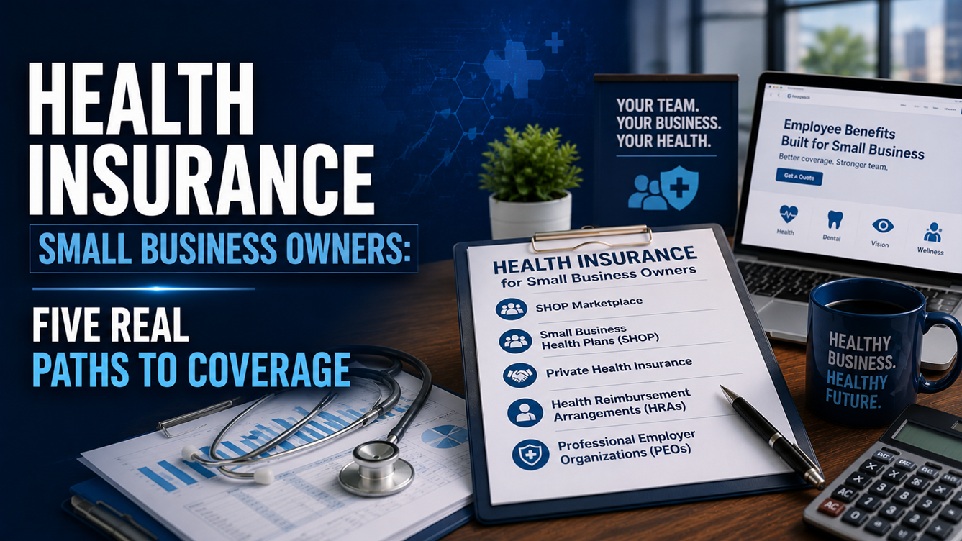
Small business owners have five practical paths to health insurance: an individual ACA Marketplace plan, coverage through a spouse’s employer plan, sponsoring a group plan that includes the owner, an ICHRA (Individual Coverage Health Reimbursement Arrangement), or a professional association plan. Which one is right depends on family situation, business size, income level, and how many employees you’d want to cover alongside yourself.
The most important factor for most owners is whether you’re covering just yourself (or yourself plus family) or you also need to cover employees. Single-owner businesses with no employees usually do best with a Marketplace plan or spousal coverage. Businesses with employees often benefit from a group plan or ICHRA arrangement that covers everyone including the owner. The HealthCare.gov small business resource center publishes side-by-side comparisons of small employer coverage options, which is the most current reference for federal small business health insurance options.
The 5 Paths Compared
| Path | Best For | Key Limitation |
|---|---|---|
| ACA Marketplace plan | Solo owners, owners without group eligibility | Premium based on personal income |
| Spouse’s employer plan | Owners married to W-2 employees | Dependent on spouse staying employed |
| Group plan (owner-sponsored) | Businesses with 2+ employees | Must offer to employees too |
| ICHRA | Businesses wanting flexibility without sponsoring a plan | Newer arrangement; administrative complexity |
| Association health plan | Members of qualifying associations | Availability varies by industry and state |
Path 1: ACA Marketplace
The Marketplace (HealthCare.gov or your state exchange) is open to self-employed people and small business owners without group coverage. Key features:
- Pre-existing conditions can’t be excluded
- Subsidies available if household income falls within eligible range
- Plans available in metal tiers (Bronze through Platinum)
- Enrollment during open enrollment (Nov 1–Jan 15 typically) or qualifying events
The self-employed health insurance deduction lets eligible self-employed individuals deduct premium costs from their adjusted gross income, which can offset the cost meaningfully.
Path 2: Spousal Coverage
If your spouse has employer coverage, joining their plan is often the lowest-cost option, especially if their employer pays a large share of dependent premiums. Considerations:
- Employer plans often have lower out-of-pocket maximums than Marketplace plans
- Spousal access depends on the employer’s eligibility rules
- Spousal carve-out provisions exist at some employers — verify before assuming access
- If you have employees, you may still want a separate plan for them
Path 3: Group Plan with Owner Included
If you have at least one W-2 employee besides yourself, you can typically sponsor a group health plan that covers both employees and owners. Key points:
- Group rates often beat individual rates for healthier groups
- Tax-deductible as a business expense
- Sets you up to attract and retain employees
- SHOP (Small Business Health Options Program) provides federal small business marketplace
A business with 25 or fewer employees may qualify for the Small Business Health Care Tax Credit, which can be substantial.
Path 4: ICHRA (Newer Option)
An Individual Coverage HRA lets an employer reimburse employees for individually purchased health insurance, pre-tax. The employer sets the monthly contribution amount; employees buy their own Marketplace plans.
Pros:
- More flexibility than group plans
- Predictable cost (employer sets the contribution)
- Employees can choose plans matched to their needs
Cons:
- Administrative complexity
- Employees navigate their own plan selection
- Newer; less broker familiarity
Path 5: Association Health Plans
Some industry associations, chambers of commerce, and professional groups offer access to group health coverage for members. Examples include the National Federation of Independent Business (NFIB) and various trade associations.
Availability varies by state and association. Worth checking if your industry has an association option, as group buying power can produce better rates.
The Self-Employed Health Insurance Deduction
For Marketplace and other individually-purchased health insurance, eligible self-employed taxpayers can deduct the full premium cost from their taxable income — even without itemizing. The deduction is limited to the net profit of the business and doesn’t apply if you (or your spouse) had access to a subsidized employer plan during the same period.
This deduction makes the after-tax cost of self-employed health insurance significantly lower than the headline premium suggests.
What to Watch For
Open enrollment timing. Missing it usually means waiting a full year unless you have a qualifying life event.
Network adequacy. Marketplace plans sometimes have narrow networks. Verify your doctors are in-network before enrolling.
Out-of-pocket maximums. Lower-tier Marketplace plans can have high deductibles. Match the deductible to what you can realistically pay if something happens.
HSA-eligible plans. Pairing a high-deductible plan with an HSA can be tax-efficient if you’re healthy and want to save for future healthcare costs.
Bottom Line
Small business owners have multiple viable paths to health coverage. The right choice depends on family structure, business size, and income. Solo owners typically do best with the Marketplace or spousal coverage. Owners with employees often benefit from sponsoring a group plan or setting up an ICHRA. Don’t skip the self-employed health insurance deduction — it can offset 22%–37% of premium costs depending on your tax bracket.
