
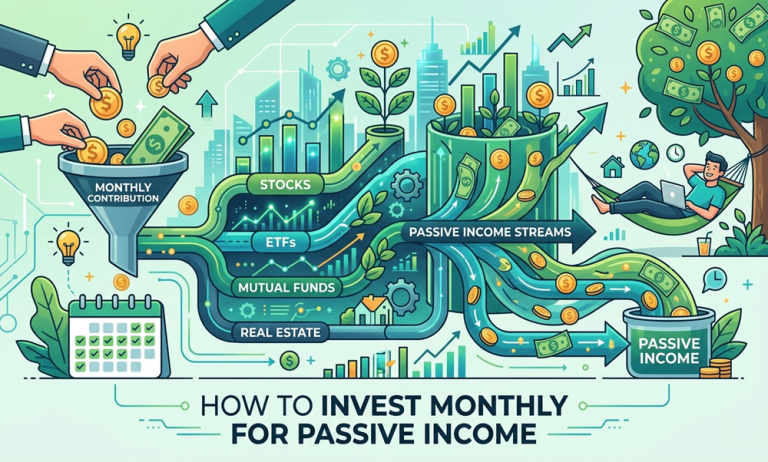
If you’ve ever thought “I wish my money worked harder than I do,” you’re already thinking like an investor. The good news: you don’t need a large lump sum to build passive income. What you need is a consistent monthly habit and a smart plan to follow.
Learning how to invest monthly for passive income is one of the most powerful financial moves you can make — and it’s far more accessible than most people realize.
Why Monthly Investing Works Better Than Lump Sum for Most People
Monthly investing — often called a Systematic Investment Plan (SIP) or dollar-cost averaging — works well for most beginners because:
- You invest automatically, removing emotion from the decision
- You buy more units when prices are low and fewer when high, averaging your cost
- It builds discipline without requiring you to time the market
- It fits around a salary or regular income
Someone investing ₹5,000/month in an index fund averaging 12% annual returns would have approximately ₹49 lakh after 20 years. That’s the math behind consistency.
How to Invest Monthly for Passive Income: Step by Step
Step 1: Decide What “Passive Income” Means for You
Are you looking for:
- Monthly cash flow (dividends, rental yields, interest)
- Wealth accumulation you’ll convert later (index funds, REITs)
- A mix of both
This goal shapes which investment types make most sense for you.
Step 2: Build a Monthly Investment Budget
A simple rule: invest at least 15–20% of your monthly take-home pay. If that’s not possible yet, start with 5% and increase it 1% every quarter.
Priority order:
- Emergency fund (3–6 months expenses)
- Employer-matched retirement contributions (free money — take it)
- Passive income investments
Step 3: Choose Your Investment Vehicles
| Investment | Monthly Income Potential | Risk Level | Minimum to Start |
|---|---|---|---|
| Dividend ETFs / Stocks | Quarterly dividends | Medium | ₹500–1,000 |
| REITs (Real Estate Trusts) | Monthly/quarterly | Medium | ₹200–500 |
| Debt Mutual Funds | Monthly income option | Low–Medium | ₹500 |
| FD / RD | Monthly interest | Very Low | ₹1,000 |
| P2P Lending | Monthly | High | ₹500–1,000 |
| Rental Property | Monthly rent | Medium (high upfront) | ₹10+ lakh |
Step 4: Automate Your Monthly Contributions
Set up a SIP on the 1st or 2nd of every month — right after salary hits. This “pay yourself first” approach ensures investing happens before spending temptations arise.
Platforms like Groww, Zerodha, Vanguard, or Fidelity make automation easy with zero transaction fees on index funds.
Step 5: Reinvest Returns Until You Need the Income
This is the step most people miss. In the early years, reinvest all dividends and returns. Let compounding do its work. Only shift to “income mode” (taking dividends as cash) once you’ve built a meaningful corpus.
Monthly Investment Strategy by Income Level
₹20,000–30,000/month income:
- SIP: ₹2,000–3,000 in Nifty 50 index fund
- FD/RD: ₹1,000 for emergency buffer
- Total: ₹3,000–4,000/month
₹50,000–80,000/month income:
- Index fund SIP: ₹5,000
- REIT: ₹2,000
- Debt fund: ₹2,000
- Total: ₹9,000–10,000/month
Expert Insight
One often-overlooked principle: the gap between your income and expenses is your actual investment power. Increasing income without controlling expenses doesn’t build wealth — but closing that gap does. Focus equally on both sides of the equation.
Common Mistakes to Avoid
- Stopping SIPs during market dips — this is actually when you want to keep investing most
- Choosing too many funds — 2–3 well-chosen funds beat 10 overlapping ones
- Chasing high-yield products without understanding risk — P2P lending and high-dividend stocks carry real default/volatility risk
- Ignoring inflation — your investments must beat inflation (currently 4–6% in India) to build real wealth
FAQs
Q: How much should I invest monthly to get passive income? Even ₹1,000–2,000/month builds meaningful wealth over 10–15 years. The key is consistency, not the amount.
Q: Which investment gives monthly income? REITs, monthly income plans (MIPs), dividend-paying stocks, and debt funds with dividend options can provide regular monthly income.
Q: Is SIP the best way to invest monthly? For most salaried beginners, yes. SIPs in diversified equity index funds are low-cost, simple, and historically strong performers over 10+ year periods.
Q: When will my monthly investments start generating passive income? With dividend or interest-focused investments, income can start immediately (though small). With growth-focused investing, expect meaningful returns in 7–15 years.
Conclusion
Monthly investing for passive income isn’t about getting rich fast — it’s about building a financial engine that works quietly in the background while you live your life. Start with what you can afford, automate it, and increase the amount as your income grows. A decade from now, you’ll be grateful you started today.