
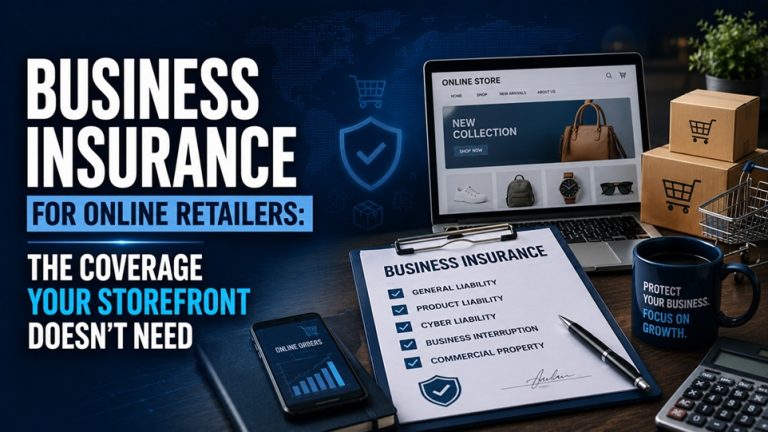
Online retailers face a different risk profile than brick-and-mortar stores, and the insurance coverage needed reflects that. The core policies most e-commerce businesses carry are general liability, product liability, cyber liability, and a business owner’s policy (BOP) that bundles property and liability coverage. Depending on your products and scale, you may also need professional liability (errors and omissions), inland marine (for inventory in transit), and commercial auto if you operate business vehicles.
The risks that make online retailers different: you don’t have foot traffic (so slip-and-fall claims are rare), but you have higher exposure to product liability, shipping issues, customer data breaches, and platform-related disputes. According to the Insurance Information Institute, cyber-related losses are among the fastest-growing categories of business insurance claims, making cyber liability essentially non-optional for any business handling customer payment data.
The Core Policies for Online Retailers
| Policy | What It Covers | Why Online Retailers Need It |
|---|---|---|
| General liability | Bodily injury, property damage to third parties | Required by most marketplaces (Amazon, Shopify Pro) |
| Product liability | Harm caused by products you sell | Critical if you make or private-label products |
| Cyber liability | Data breaches, ransomware, customer payment exposure | You’re storing or processing customer data |
| Business owner’s policy (BOP) | Bundles general liability + property | Cost-efficient for most under-$5M revenue businesses |
| Inland marine | Inventory in transit or in temporary storage | Protects shipments and 3PL-held inventory |
| Commercial auto | Vehicles used for business | Only if you operate delivery vehicles |
Why Marketplace Selling Adds Specific Requirements
If you sell on Amazon, Walmart, Etsy, or similar marketplaces, the platform itself may require specific coverage:
- Amazon Pro Sellers with $10,000+ monthly sales must carry $1 million in commercial liability
- Walmart Marketplace requires $1M general liability for many product categories
- Shopify Plus doesn’t mandate coverage but contractually shifts liability to merchants
The marketplace requirement is the minimum, not the recommendation. If you sell a product that hurts someone, the lawsuit follows your business, not the platform.
Product Liability Is the Big One
Even resellers face product liability exposure. The doctrine of “strict liability” in most states means anyone in the chain of distribution can be sued for a defective product — including a small Shopify store that just resold something.
Categories with high product liability exposure:
- Cosmetics and skincare (allergic reactions, contamination)
- Food and supplements (contamination, mislabeling, allergic reactions)
- Children’s products (safety standards, choking hazards)
- Electronics (fire, electrical injury)
- Apparel (chemical sensitivities, fire safety on children’s items)
If your products fall in these categories, $1M general liability is the floor, not the ceiling. Many retailers in these categories carry $2M–$5M.
Cyber Liability Specifics
Cyber coverage typically includes:
- First-party coverage — your costs to respond to a breach (forensics, notification, credit monitoring for customers)
- Third-party coverage — your liability to customers whose data was exposed
- Cyber extortion — ransomware payments and recovery
- Business interruption — lost revenue if your site goes down due to attack
For a small e-commerce business handling 10,000+ customer records, basic cyber coverage typically costs $500–$2,500 per year.
Typical Cost Ranges for E-Commerce Businesses
| Revenue Range | Typical Annual Premium for Full Stack |
|---|---|
| Under $250K | $1,500–$3,500 |
| $250K–$1M | $2,500–$7,500 |
| $1M–$5M | $5,000–$15,000 |
| $5M–$10M | $15,000–$40,000 |
| $10M+ | Custom commercial coverage |
Premiums vary significantly by product category — selling vitamins costs more to insure than selling phone cases.
When to Add Professional Liability
If your business gives advice, recommendations, or services along with products — fitness coaches selling supplements, consultants selling courses, marketing agencies selling tools — professional liability (errors and omissions) protects against claims that your advice or service caused financial harm.
Common Mistakes Online Retailers Make
Skipping product liability for “I just resell” reasoning. Strict liability doesn’t care if you made it or not.
Underinsuring on cyber. Most breach responses cost $100,000+; a $50,000 cyber policy isn’t meaningful coverage.
Buying coverage only when a platform forces it. Amazon’s $1M minimum isn’t a reasonable maximum.
Ignoring jurisdiction issues. Selling nationwide exposes you to product liability laws in every state.
Bottom Line
Online retailers need a layered insurance stack — general liability, product liability, cyber, and a BOP at minimum — and the cost is modest relative to the exposure. The single highest-ROI move is matching product liability limits to your actual product category risk. A vitamin business needs more coverage than a phone-case business. Get quotes from at least two commercial insurance brokers familiar with e-commerce, and update coverage annually as your revenue and product mix change.