
When you’re new to credit cards, the terminology alone can be confusing. Secured, unsecured, deposit, limit — what does it all mean, and which type should you actually get?
This guide cuts through the jargon and gives you a practical answer.
The Core Difference
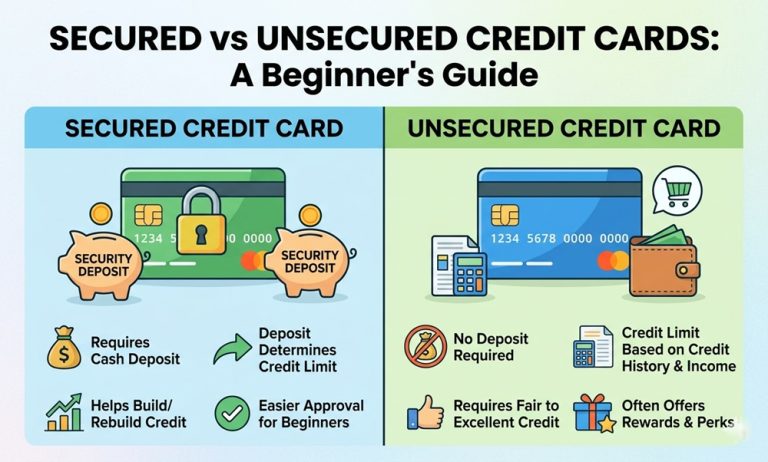
Secured credit card: You deposit money upfront. That deposit typically becomes your credit limit. If you deposit $300, you can spend up to $300.
Unsecured credit card: No deposit required. The lender extends you credit based on your creditworthiness — your score, income, and credit history.
That’s the fundamental difference. Everything else flows from there.
Secured Cards: How They Actually Work
Think of a secured card as training wheels with a safety net — for the lender. You put down cash, they give you a card that works exactly like any other credit card. You swipe, you pay, it reports to the credit bureaus.
The deposit isn’t a payment. You get it back when you close the account or upgrade to an unsecured card.
Key features of secured cards:
- Approval is easier — some require no credit check
- Deposit ranges typically from $200 to $2,500
- Credit limit equals your deposit in most cases
- Interest rates tend to be higher (20–29% APR is common)
- Many graduate to unsecured cards after 6–12 months
Unsecured Cards: What You Need to Qualify
Without collateral, lenders rely entirely on your credit profile. For beginners, unsecured cards designed for new borrowers (like student cards or fintech cards) have lighter requirements. Traditional unsecured cards typically require a credit score of 670+.
Key features of unsecured cards:
- No deposit required
- Credit limit set by the issuer
- Better rewards programs at higher tiers
- Generally lower APRs for well-qualified applicants
- Harder to get with no or thin credit history
Side-by-Side Comparison
| Feature | Secured Card | Unsecured Card |
|---|---|---|
| Deposit required | Yes ($200–$2,500) | No |
| Credit check | Often none or soft | Usually yes |
| Best for | No/bad credit | Fair to excellent credit |
| APR | Higher (20–29%) | Varies (14–26%) |
| Rewards | Rarely | Common |
| Credit-building power | Same as unsecured | Same as secured |
| Upgrade path | Often available | N/A |
Which One Should You Choose?
Choose a secured card if:
- You have no credit history
- You’ve been denied for unsecured cards
- You want to rebuild after past credit issues
- You’re comfortable depositing $200–$500
Choose an unsecured card if:
- You’re a college student (student cards require no deposit)
- You have some credit history already
- You want to avoid tying up cash as a deposit
- A fintech card is available that fits your situation
Common Mistakes to Avoid
- Assuming secured cards are “lesser” products — they build credit just as effectively as unsecured cards.
- Not checking if the card graduates — if it doesn’t automatically convert to unsecured, your deposit is locked away longer.
- Closing your secured card after getting an unsecured one — closing accounts shortens your credit history and can hurt your score.
- Ignoring the APR — if you carry a balance, high interest on a secured card is expensive.
Pro Tips
- Always confirm a secured card reports to all three credit bureaus — some don’t, which defeats the purpose.
- Set up autopay for the full statement balance to avoid interest entirely.
- After 6 months of on-time payments, call your issuer and ask about upgrading — sometimes they don’t do it automatically.
FAQs
Q: Does a secured card build credit as fast as an unsecured card? Yes — credit bureaus don’t distinguish between the two. Payment history and utilization matter more than the card type.
Q: Can I get an unsecured card with no credit history? Yes, through student cards or fintech options like Chime Credit Builder. But most traditional unsecured cards require some history.
Q: Is my deposit safe? If the issuer is FDIC-insured (almost all major ones are), yes — your deposit is protected up to $250,000.
Q: How long until I get my deposit back? Typically when you close the account or when your card graduates to unsecured — usually after 6–18 months of good behavior.
Q: What’s a good secured card deposit amount? Start with $300–$500. Higher deposits give you more spending flexibility and can help keep your utilization ratio lower.
Conclusion
For most beginners, a secured card is the most accessible and reliable starting point. It’s not a lesser product — it’s the right tool for the job. Once you’ve used it responsibly for a year, you’ll be in a strong position to qualify for unsecured cards with real rewards. The deposit is temporary; the credit history you build lasts.