
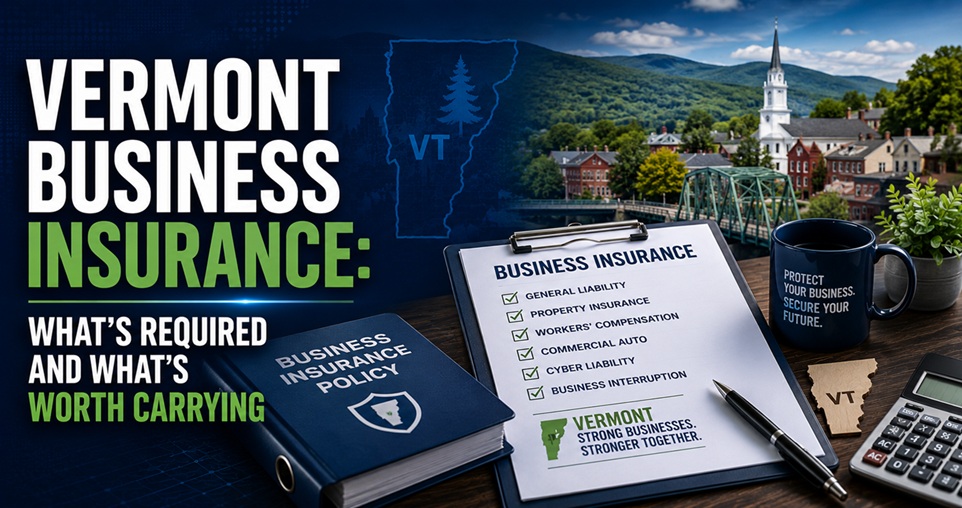
Vermont business insurance requirements are straightforward: workers’ compensation is mandatory for any business with one or more employees (full-time, part-time, or seasonal), and businesses with commercial vehicles must carry commercial auto insurance meeting state minimums. Most other coverages — general liability, professional liability, cyber, property — are recommended but not legally required. The exception: certain regulated industries (construction contractors, healthcare providers, financial services) face additional state-specific licensing and insurance requirements.
Vermont is also unique nationally as the largest captive insurance domicile in the United States, hosting over 600 captive insurance companies as of recent state filings. For larger businesses (typically $5M+ in revenue), Vermont’s captive structure can be a meaningful tool for self-insurance and risk management — though it’s overkill for most small businesses. The Vermont Department of Financial Regulation publishes current information on business insurance requirements and licensed insurers in the state, making it the right starting point for any compliance-related questions.
Vermont Insurance Requirements at a Glance
| Coverage | Required? | Who Needs It |
|---|---|---|
| Workers’ compensation | Yes (1+ employees) | All employers, including part-time/seasonal |
| Commercial auto liability | Yes (for business vehicles) | Vehicles used for business purposes |
| General liability | No (recommended) | All businesses serving the public |
| Professional liability | Industry-specific | Doctors, lawyers, accountants, consultants |
| Property insurance | No (recommended) | Businesses with physical assets |
| Cyber liability | No (recommended) | Businesses handling customer data |
| Unemployment insurance | Yes (via state) | All employers (paid through state) |
| Disability insurance | No state mandate | Optional for owners and employees |
Workers’ Comp: Vermont’s Strict Rule
Vermont is one of the strictest states on workers’ compensation: coverage is required from the first employee, with very limited exceptions. Sole proprietors and partners can elect to be excluded from their own policy, but they cover any other workers — including family members in many cases — and including 1099 contractors if the work relationship resembles employment.
The penalties for non-compliance:
- Fines up to $250 per day per uninsured employee
- Stop-work orders that shut down operations
- Personal liability for employee injuries
- Possible criminal charges in serious cases
Vermont workers’ comp is sold through the private market, with Vermont’s State Insurance Department setting rates and rules but private insurers writing policies.
Industry-Specific Requirements
Several Vermont-licensed industries face additional insurance requirements:
| Industry | Additional Requirement |
|---|---|
| Construction contractors | Surety bonds, additional liability |
| Healthcare providers | Malpractice/professional liability |
| Real estate brokers | Errors and omissions coverage |
| Childcare facilities | Specific liability coverage minimums |
| Restaurants serving alcohol | Liquor liability |
Check with the relevant state licensing board for current minimum requirements in your industry.
Captive Insurance: Vermont’s Unique Position
Vermont established its captive insurance law in 1981 and has since become the largest captive domicile in the United States. A captive is essentially a self-insurance vehicle owned by the business it insures — used by mid-size and large companies to manage risk more efficiently than buying commercial coverage.
For most small businesses, captive insurance isn’t relevant. It becomes worth considering at:
- $5M+ in premium-equivalent risk costs
- Specific niche industries with limited commercial coverage availability
- Multi-entity businesses wanting consolidated risk management
If you’re a $500K revenue business in Vermont, this isn’t your tool. If you’re a $50M revenue business, it’s worth a conversation with a captive specialist.
Typical Cost Ranges in Vermont
| Coverage | Annual Cost (Small Business) |
|---|---|
| Workers’ comp (varies by industry) | $0.10–$5.00 per $100 of payroll |
| General liability | $400–$1,500 |
| BOP (general liability + property) | $750–$2,500 |
| Commercial auto | $1,200–$2,500 per vehicle |
| Cyber liability | $500–$2,500 |
A typical Vermont small business with 3 employees and $300K in revenue might spend $3,000–$6,000 annually on full insurance coverage.
Working with Vermont Insurance Brokers
Vermont’s small market means most insurance is sold through independent agents and brokers. Benefits of working with a local Vermont broker:
- Familiarity with Vermont-specific requirements
- Relationships with Vermont-based insurers
- Knowledge of industry-specific regulations
- Local claims service
The state requires all insurance brokers to be licensed through the Vermont Department of Financial Regulation. You can verify any broker’s license through the department’s online database.
Common Vermont Business Insurance Mistakes
Misclassifying employees as 1099 contractors to avoid workers’ comp. Vermont labor authorities aggressively investigate this.
Buying only the legally required minimum. Workers’ comp alone doesn’t protect you from customer lawsuits, property damage, or cyber incidents.
Skipping cyber coverage. Vermont businesses are not exempt from data breach exposure.
Not reviewing coverage annually. Vermont rates and minimums change; a policy that fit three years ago may be inadequate now.
Bottom Line
Vermont business insurance starts with mandatory workers’ compensation for any business with employees, then adds optional but practical coverages — general liability, property, cyber — based on your industry and risk exposure. The state’s unique captive insurance market is irrelevant to most small businesses but worth knowing about as you grow. Get at least two quotes from Vermont-licensed brokers and update coverage annually as your business changes.
